


Delhi - Bodh Gaya - Rajgir - Nalanda - Kushinagar - Lumbini - Sarnath - Varanasi -
This journey follows the life path of Gautama Buddha, moving through the places where his teachings were formed, shared, and preserved. Designed for international travelers seeking historical depth and spiritual clarity, the Ultimate Buddhist Circuit of India & Nepal connects sacred sites that continue to shape Buddhist thought across the world.
Rather than presenting these destinations as isolated monuments, the itinerary places them within a living philosophical landscape. Each stop offers insight into Buddhist values such as mindfulness, compassion, impermanence, and self-awareness. The pace remains balanced, allowing time for reflection, learning, and quiet observation.
Arrival in Delhi introduces travelers to India’s historical gateway. After transfer to the hotel, time is provided to rest and adjust. Delhi represents the point where ancient philosophy and modern India intersect, offering context for the journey ahead.
Later, a gentle orientation helps set the tone for the pilgrimage. Discussions around Buddhist history and the route ahead provide intellectual grounding, preparing travelers for the spiritual depth of the coming days.
Travel continues toward Bodh Gaya, one of the most sacred destinations in the Buddhist world. This is the place where Buddha attained enlightenment, and the atmosphere reflects deep reverence and calm.
Upon arrival, time is given to absorb the surroundings. Monks from different traditions, pilgrims from across continents, and the quiet rhythm of prayer create an environment of shared devotion. The day focuses on presence rather than activity.
This day allows deeper engagement with Bodh Gaya’s spiritual environment. The sacred area offers opportunities for quiet observation, meditation, and understanding the symbolic meaning of enlightenment in Buddhist philosophy.
Travelers gain insight into how Bodh Gaya functions not only as a pilgrimage site but also as a global center of learning and contemplation. The experience emphasizes silence, awareness, and respect for the sacred space.
The journey moves to Rajgir, a place closely associated with Buddha’s teachings and monastic discipline. The natural surroundings create a contemplative atmosphere where learning and renunciation were practiced side by side.
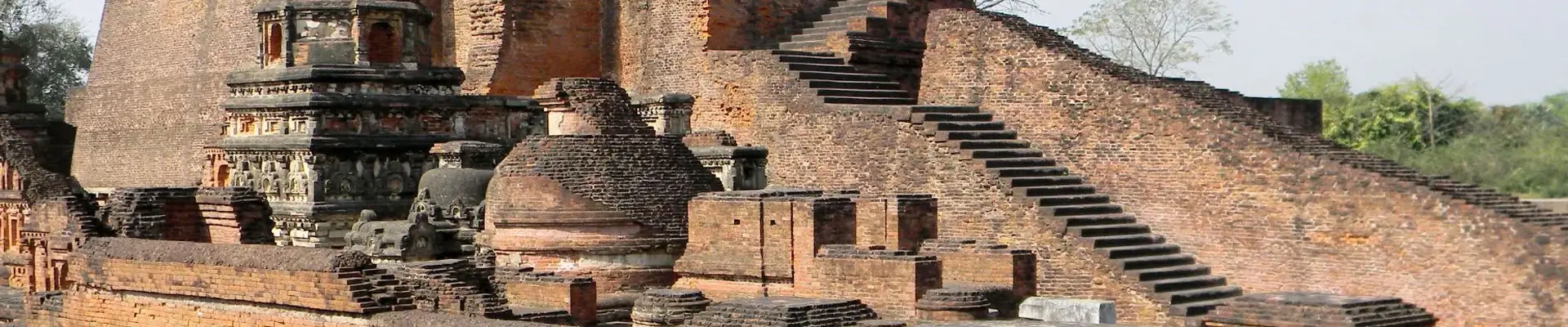
Nalanda follows, once the world’s most influential Buddhist learning center. The ruins reflect intellectual depth and scholarly exchange that shaped Buddhist philosophy across Asia. Time is spent understanding the significance of education, debate, and discipline in Buddhist tradition.
Travel continues toward Kushinagar, the place where Buddha attained Mahaparinirvana. The journey itself allows time for reflection as landscapes gradually change.
Upon arrival, the atmosphere is calm and respectful. Kushinagar carries a sense of completion rather than loss, emphasizing Buddhist understanding of impermanence and liberation. The experience encourages contemplation rather than explanation.
Crossing into Nepal, the journey reaches Lumbini, the birthplace of Gautama Buddha. This destination represents beginnings rather than endings, offering a gentle contrast to Kushinagar.
Lumbini’s international monasteries and peaceful gardens create a universal spiritual space. Time is provided to absorb the diversity of Buddhist expression while maintaining the core values of simplicity and mindfulness.
The route returns toward India, reaching Sarnath near Varanasi. Sarnath holds special importance as the place where Buddha delivered his first sermon.
The environment here is quiet and scholarly, reflecting the moment when Buddhist teaching was first shared with the world. Travelers gain clarity on the transition from personal awakening to shared wisdom.
Varanasi introduces a broader spiritual dimension. While not exclusively Buddhist, the city provides context to India’s long philosophical tradition.
Time is spent observing how spiritual life flows continuously through daily rituals. The contrast between Buddhist silence and Hindu ceremonial rhythm enhances understanding of India’s layered spiritual heritage.
This day allows unhurried reflection. Morning and evening hours offer contrasting spiritual energies, creating space for personal contemplation.
Varanasi provides emotional grounding before the journey concludes, helping travelers process the teachings, environments, and insights gathered throughout the pilgrimage.
After breakfast, transfer arrangements are made for onward travel. The journey concludes quietly, leaving travelers with a deeper understanding of Buddhist philosophy and its timeless relevance.
Get Tour Quotation in 15 Minutes
Yes, it suits both practitioners and those interested in Buddhist history.
No, meditation is optional and self-guided.
The itinerary is gentle and suitable for most travelers.
Yes, all transfers between India and Nepal are managed.
This itinerary is designed as a private experience.
Yes, guides can be arranged where required.
Yes, Lumbini is calm and well-organized for visitors.
It balances historical, philosophical, and spiritual understanding.
Yes, customization is possible.
Yes, the route is structured and culturally accessible.